This statement is made in accordance with the United Kingdom’s Modern Slavery Act 2015 and Canada’s Fighting Against Forced Labour and Child Labour in Supply Chains Act 2023 and covers the reporting period from 1 January 2025 to 31 December 2025.
This statement is made on behalf of Hikma Pharmaceuticals PLC, including its subsidiaries and the companies owned or controlled by it. The reporting entities covered by this joint statement are listed in Annex 1.
Unless expressly stated otherwise, references to ‘Hikma’, ‘we’, ‘us’ and ‘our’ refer to the companies comprising the Hikma group, and include the reporting entities listed in Annex 1 and all subsidiaries and companies owned or controlled by Hikma Pharmaceuticals PLC.
Our commitment
We are committed to conducting our business with the highest ethical standards and in compliance with applicable national and international laws, regulations and codes. As a signatory of the United Nations Global Compact since 2007, we report annually on our progress. We have also been constituents of the FTSE4Good Index since 2014, reflecting our continued alignment with recognised environmental, social and governance standards.
We have controls in place to prevent and address modern slavery risks within our operations and supply chains and we continue to strengthen these measures. We expect our partners, suppliers and third parties to do the same (see the Supplier and Third Party Management Process section below). This statement summarises the steps we took in 2025 to mitigate modern slavery risks; our previous statements are available here.
Our business structure
We help put better health within reach every day for millions of people around the world.
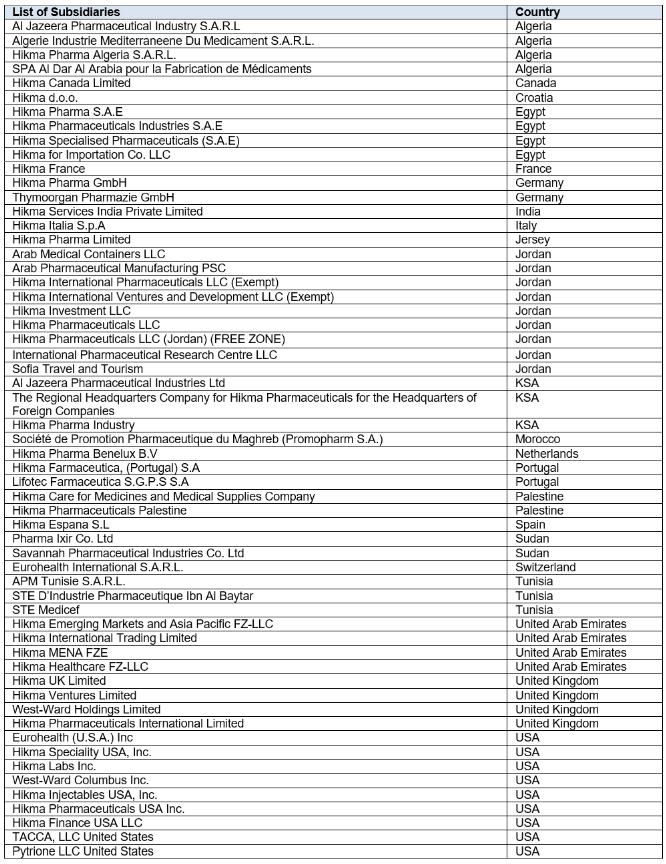
Hikma operates globally through a network of 58 subsidiaries owned or controlled by Hikma Pharmaceuticals PLC, a publicly traded company headquartered in London, United Kingdom. We have a local presence in North America, the Middle East and North Africa (MENA), and Europe, with manufacturing and research and development (R&D) operations in each region. A list of our subsidiaries and the countries where we have a presence is provided in Annex 2 and in our Annual Report.
Our operating model currently comprises business segments that develop, manufacture and market pharmaceutical products. In the Rx segment, we supply oral, respiratory and other generic and specialty products to the North America retail market. Our Injectables segment supplies generic and specialty injectable products to hospitals across our markets, supported by manufacturing facilities in the US, Europe and MENA. Our Branded segment provides branded generic and in-licensed products from local manufacturing facilities to retail and hospital customers across MENA.
We operate a global network of 3 R&D hubs and 29 manufacturing plants, supported by continued investment in R&D and partnerships. In 2025, we launched 84 new products, received 99 approvals and submitted 139 regulatory filings to support our product pipeline. Our product portfolio can be found here.
During 2025, our core revenue was $3,349 million, with North America contributing 59%, MENA 32.5%, and Europe and the rest of the world 8.5%. Our venture capital arm, Hikma Ventures, invests in opportunities in digital health and life sciences to support the development of innovative health technologies. We have approximately 9,400 colleagues across our markets.
Further details on our business structure, operations and workforce are available in our Annual Report.
Our supply chain
Due to the global nature of our operations, our supply chains are complex and operate at scale. We source a wide range of goods and services from thousands of suppliers worldwide and partner with wholesalers and distributors to supply our products to patients.
We source goods and services to support our manufacturing and R&D operations, such as raw materials and pharmaceutical ingredients for drug substances and finished products; clinical trial support; machinery, equipment and laboratory supplies; and materials used for primary and secondary packaging.
We also source goods and services to support our business, including equipment and office supplies; technologies, digital solutions and IT systems and services; and professional services. We also engage suppliers and third parties for services such as catering, facilities management, warehousing, transport, R&D and clinical studies, engineering, and construction.
We partner with a network of external distributors whose support makes our products available to those who need them, as well as contract manufacturing organisations that supply finished and semi-finished products for sale and distribution by Hikma.
In 2025, we spent approximately $2.2 billion with over 7,500 suppliers and third parties. The highest category of our supplier spend during this period was direct materials essential for supporting our pharmaceutical production operations, including raw materials (active pharmaceutical ingredients and excipients) and packaging. In terms of indirect spend, the highest spend categories were machinery and equipment, professional services, warehousing and logistics, and construction.
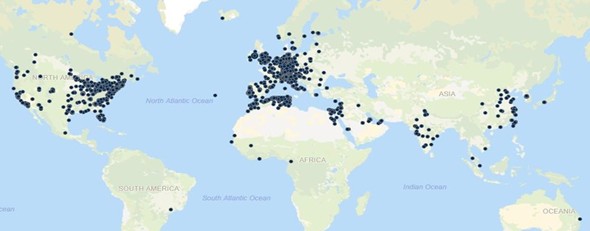
We continue to map our operations and supply chains, including risks associated with supply categories and the location of our suppliers. Our Tier 1 suppliers operate in 67 countries worldwide, including the United States, Ireland, Switzerland, China, Jordan and India. Approximately 36% of our total supplier expenditure is allocated to suppliers based in North America, 39% in Europe, and 25% across suppliers in MENA, Asia and other regions.
The geographical distribution of our suppliers, by country, is illustrated on the map below.
In 2025, to improve our understanding of the workforce within our direct supply chain, we conducted an analysis of our Tier 1 suppliers, representing approximately 70% of our total procurement expenditure.
Based on this analysis, we estimate that our Tier 1 raw-material suppliers employ approximately 1 million workers globally, with the highest concentrations in the United States, China, India and Europe. We also estimate that our Tier 1 service suppliers, including construction, facilities management, warehousing and logistics, employ approximately 150,000 workers, with notable concentrations in Jordan, the Kingdom of Saudi Arabia, Portugal and the United States.
These estimates are derived from publicly reported employee data and industry-average workforce sizes for private companies. Where a supplier operates across multiple countries, its global workforce is counted once to avoid double counting. These figures are estimates, covering approximately 70% of our 2025 supplier spend, and do not capture the full extent of our supply chain workforce.
Identifying modern slavery risks in our operations and supply chain
Based on our risk assessment and the nature of our operations, we continue to believe that the risk of modern slavery in our directly employed workforce remains low. This is mainly due to our strict adherence to the laws and regulations that apply to us, the enforcement of our policies and procedures, the educated and highly skilled nature of our workforce, and the heavily regulated and controlled nature of the pharmaceutical industry.
However, we recognise that the risk in our operations potentially increases in employment settings where workers may be regarded as more vulnerable, including certain groups such as contract and migrant workers in some countries.
To support our ongoing work to identify and mitigate these risks, we analysed our workforce and identified the different groups of migrant (foreign) and contract workers within our direct operations. Based on this analysis, we developed a framework that formalises our commitment to protecting workers’ rights and mitigating potential risks, in alignment with our broader approach to human rights (see the Employment processes section below). Overall, we continue to assess the risk of modern slavery within our operations as low, reflecting our disciplined employment practices and the controls and safeguards in place.
Our due diligence indicates that modern slavery risk in our supply chain is higher in some countries within our contracted workforce and in engagements with third parties, particularly in higher-risk jurisdictions with weaker enforcement of international human rights standards. Higher exposure may also arise in certain industries related to commodities and raw materials and in services such as construction; transport; contingent labour (including cleaning, security and hospitality); logistics; and warehousing. We have identified the sourcing of active pharmaceutical ingredients and raw materials from China and India, and packaging materials and services provided in countries within the MENA region (including Jordan), as higher-risk areas within our direct supply chain.
Due diligence process
Our due diligence process is based on strict adherence to applicable laws and regulations and incorporates labour and human rights criteria. Suppliers and third parties are screened through our Third Party Onboarding and Management tool and are categorised based on multiple risk factors, which take into account risks related to ethical, legal and financial matters as well as exploitative, unsafe, or abusive work conditions, which are indicative of modern slavery. In assessing supplier risk, we consider various risk factors including the geographic location or country risk profile of the supplier, the nature/type of goods or services, and the supplier’s internal controls and standards. Additionally, we scrutinise each supplier’s enforcement history, existing sanctions, and any related adverse information during the pre-qualification and onboarding phase. Audits are conducted on suppliers who manufacture active pharmaceutical ingredients, in compliance with regulatory requirements as they may apply to our operations.
Multiple indices are used to assess country-specific risks based on the prevalence of modern slavery, ethical standards, and human rights enforcement. These indices include, but are not limited to, the Walk Free Global Slavery Index and the Transparency International Corruption Perceptions Index. Beyond country risk profiles, we assess modern slavery risks associated with different categories of goods and services based on various governmental guidelines and indices, including the US Department of Labor’s List of Goods Produced by Child Labor or Forced Labor. We have also consulted various publicly available material regarding the pharmaceutical industry, such as the Rights DD, Pharmaceutical Supply Chain Initiative and other standards.
We continue to use targeted modern slavery questionnaires to help identify and assess risks within our supply chain and to improve visibility beyond our Tier 1 suppliers. The questionnaires cover, among other areas, suppliers’ internal controls, labour practices, workforce composition (including the use of migrant, contract, temporary or seasonal workers), screening across their own operations and extended supply chains, and the measures they implement to prevent modern slavery. Suppliers that score as high risk on the basic questionnaire are required to complete an enhanced questionnaire to support further assessment. More information on the resources used to develop our questionnaires is available in our Modern Slavery Statement 2024.
Based on this assessment and review, suppliers are assigned a risk rating, categorising the level of risk in the business relationship as low, medium or high. In 2025, 81% of our assessed supplier base had a low-risk profile, 17% had a medium-risk profile, and 3% had a high-risk profile; none were rated high risk for modern slavery concerns. High-risk suppliers undergo additional investigation and monitoring, as further described in the Supplier and third party management process section below.
To improve our visibility beyond our Tier 1 suppliers and to gain insight into how our direct suppliers manage modern slavery risks within their own supply chains, we continue to use the EcoVadis sustainability assessment platform which evaluates the management practices used by participating suppliers in their own supply chains. In 2025, we also used the IQ+Vitals screening tool to help us monitor adverse information and risks across our supplier base and improve our visibility into our supply chain. IQ+Vitals evaluates human rights conditions in the countries in which suppliers operate, incorporates sector-specific risk by assessing ESG challenges associated with each supplier’s industry, and draws on procurement data, supplier publicly provided information, and ongoing media monitoring to identify potential issues related to human rights, ethics, and broader sustainability concerns associated with a supplier. It also considers alignment with applicable laws and regulatory frameworks. In 2025, we successfully expanded supplier participation in the EcoVadis platform to cover 47% of our global procurement spend. This represents an increase of 11% from the number of suppliers participating in 2024. In addition, suppliers representing approximately 75% of our total supplier spend are now screened using IQ+Vitals.
Legacy suppliers
In 2025, we continued to assess our legacy suppliers for modern slavery risks and extended this assessment to include suppliers of materials and commodities (including packaging and raw materials) that meet a defined spend threshold, regardless of geographical location. These suppliers were prioritised due to the higher inherent risks associated with these categories. The assessment applied the risk criteria described in the Due diligence process section above and covered suppliers representing approximately 12% of our 2025 spend. Of these, 53 were identified as high risk and were issued with corrective action plans.
Preventing and addressing modern slavery risks
Supplier and third party management process
We manage modern slavery risk in our supply chain through our Third Party Onboarding and Management tool, which applies the risk factors and process described in the Due diligence process section above. The tool helps us assess labour and human rights risks before we enter into a commercial relationship and supports ongoing monitoring so that changes in risk profile are identified and managed. As noted earlier, suppliers assessed as medium or high risk are subject to enhanced due diligence and further evaluation.
Our response to modern slavery risks is determined on a case-by-case basis in collaboration with relevant functions, including Compliance, Procurement and Legal. The actions taken depend on multiple factors such as the nature, severity and likelihood of the risk, the underlying cause of any non-compliance, and the degree of influence we can exercise.
Where modern slavery risks are identified, our approach may include direct engagement with the supplier, requests for supporting documentation (such as policies, procedures and assurances demonstrating compliance with labour and human rights standards), the development and implementation of corrective action plans, formal investigations where appropriate, and the commissioning of audits. Where necessary, we may also explore alternative sourcing options or terminate the business relationship if concerns are not adequately addressed or the level of risk is deemed unacceptable.
In 2025, we continued to strengthen our supplier risk management approach through our collaboration with EcoVadis and the introduction of IQ+Vitals, which has enhanced our ability to assess and monitor a broader base of suppliers more efficiently. As noted in the Due diligence process section above, these tools enable us to evaluate supplier performance, categorise suppliers based on risk scores, and identify potential human rights, ethical and sustainability issues. Where risks are identified, we engage with suppliers through targeted questionnaires and corrective action plans to support remediation and continuous improvement.
Where corrective action plans are developed, our Procurement and Compliance teams work closely with suppliers to support effective remediation. Progress is monitored on an ongoing basis, with oversight from senior members of these functions to ensure timely and effective resolution.
The majority of suppliers identified as high risk through our labour and human rights screening tools were classified as such due to inherent country or sector risks, or a lack of sufficient evidence or documentation demonstrating effective management of labour and human rights issues. Our engagement with these suppliers is aimed at supporting them in addressing identified gaps, including the provision of relevant documentation and the implementation of corrective actions.
Governance
Our Corporate Compliance Programme, including our approach to modern slavery, is overseen at the highest levels of the organisation. It is governed by the Board-level Compliance, Responsibility and Ethics Committee (“CREC”), which supports the Board of Directors in fulfilling its compliance and risk management responsibilities and provides oversight of ethical issues relating to suppliers, including modern slavery. The terms of reference for the CREC are available here, and details of our Board of Directors can be found here.
Our Chief Compliance Officer (“CCO”) is a member of senior management and is responsible for the day-to-day management of Hikma’s Compliance Programme, including policies, training, auditing, monitoring and oversight of investigations. To ensure the highest level of oversight, our CCO maintains a direct, unfiltered reporting line to the Chair of the CREC and provides regular reports to Hikma’s Executive Committee and the CREC. The Board of Directors also oversees our risk programme and receives reports on relevant matters, including third-party management and ethics and compliance risks.
Hikma’s Modern Slavery Taskforce (“MS Taskforce”) comprises senior members from Legal, Procurement, Compliance and People/Human Resources. The MS Taskforce meets monthly (or more frequently if required) to coordinate action on modern slavery risks across our operations and supply chains. In 2025, we introduced permanent HR representation to strengthen communication on employee and contractor engagement policies and practices. The MS Taskforce also consulted professional advisers and risk assessment specialists, including Moody’s, EcoVadis and Dun & Bradstreet, to identify opportunities to enhance our processes and procedures.
The MS Taskforce also supports awareness-raising and function-specific training on due diligence processes, legislative requirements and risk mitigation. Its work is reported regularly to senior management and presented to the Board of Directors annually.
Codes and policies
We are committed to best practice across our operations and supply chains. We work alongside industry partners to uphold ethical labour practices and safeguard human rights.
Our Code of Conduct (“Code”) sets out the core standards and ethical behaviours that we expect our employees, contractors, and third parties with whom we contract or do business to apply and uphold, including compliance with human rights and labour rights principles and modern slavery laws. The core principles enshrined in our Code are underpinned by a number of group, regional and local policies, procedures and guidelines that help uphold our values and mitigate against human rights violations and the risk of modern slavery.
Our Supplier Code of Conduct reinforces these commitments by setting clear expectations for suppliers, partners, and third parties. It requires them to operate in alignment with our values, explicitly prohibits the use of forced labour, child labour or modern slavery, and promotes responsible practices throughout their own supply chains. Our Supplier Code of Conduct also includes an explicit expectation that modern slavery standards will be cascaded down the value chain and imposes a responsibility on our suppliers to ensure that their own suppliers and contractors are subject to the same standards, restrictions, and expectations as their own. Additionally, it requires our suppliers to demonstrate that they have undertaken reasonable enquiry into, and are not aware of, any instances of modern slavery directly or indirectly linked to their business operations, products, or services. The Supplier Code of Conduct and our Code also include details of our Speak-Up channels, enabling suppliers and others to report concerns related to misconduct or potential modern slavery.
As part of our commitment to promoting human and labour rights and ensuring these principles are effectively implemented in our operations, we have established a range of supporting policies and procedures. These include health and safety protocols, risk assessment and due diligence processes to evaluate supplier and third party compliance with ethical and legal obligations, and a robust whistleblowing infrastructure to enable the reporting of concerns or misconduct. We also maintain an investigation framework to address any instances where rights may be compromised, as well as policies designed to support fair employment practices. Our policies are approved by the senior leadership team and are communicated to employees at regular intervals through a range of channels. They are published on our internal intranet, ensuring accessibility to all staff, and are supported by targeted in-person training initiatives as needed to promote understanding and strengthen compliance. More information on our policies and processes is provided under the ‘Our Commitment’ section in our Modern Slavery Statement 2023.
We regularly review our Code, Supplier Code of Conduct, and related policies to ensure they remain effective, relevant, and aligned with evolving risks and best practices. This review process involves input from key stakeholders, including the Board of Directors when appropriate or required, and supports our culture of continuous improvement and accountability.
In 2025, we identified a number of policies and statements to reinforce our commitment to conduct our business in accordance with the highest ethical conduct and best practices. These include, but are not limited to, a stand-alone Human Rights Statement which aligns with the UN Guiding Principles on Business and Human Rights (“UNGP”) and reinforces our commitment to conducting business in a responsible and ethical manner, grounded in respect for human rights across all our operations and relationships, upholding the dignity of our employees, providing a safe workplace that is free from discrimination, and ensuring appropriate standards of wellbeing and privacy.
Our Human Rights Statement, as well as all our statements and positions, including Modern Slavery Statements, are available publicly on our website.
Contractual Clauses
As part of our approach to managing risk throughout the contractual relationship, suppliers acknowledge compliance with the prohibition of modern slavery and our Supplier Code of Conduct, which sets expectations for ethical conduct and compliance with human rights standards. These expectations are reinforced through contractual provisions that expressly require compliance with our Code and ethical standards, the Modern Slavery Act (and equivalent legislation), and applicable laws and regulations. We reserve the right to terminate supplier relationships in cases of non-compliance with legal requirements, including modern slavery legislation, or with the standards set out in our Code. Information on the standard clauses in our supplier contract templates is provided in our Modern Slavery Statement 2022.
Training
Our approach to modern slavery training is tailored based on our employees’ risk of exposure to modern slavery. All our employees are required to complete basic training on modern slavery risks as part of our Code training. In addition, we provide more specialised training for employees whose roles involve greater exposure to modern slavery risks or who are more likely to encounter such issues in the course of their work.
Our Code provides guidance to our employees and partners on the ethics of Hikma’s business activities through the identification and discussion of various risks associated with our business. As a basic training requirement on modern slavery, all our employees, officers and directors have undertaken training on our Code, which raises awareness of the risks of slavery and human trafficking and other legal and ethical considerations, such as privacy, health and safety, and bribery and corruption. The training also covers how to respond to any misconduct and violations and clarifies internal escalation channels for reporting misconduct and/or voicing grievances. The training is available in multiple languages. As of 2025, the training had a completion rate of 99%.
In 2025, we introduced an advanced/specialist training programme for employees in higher-priority roles focusing on modern slavery and human trafficking. The training, delivered through our e-learning platform, provides detailed information on the different forms of modern slavery, how to identify modern slavery in an organisation’s operations and supply chains, examples and relevant risk indicators, and available reporting mechanisms. The training was assigned to over 20% of employees in our Operations, Legal, Procurement, Commercial, People, R&D and Compliance functions, and has been completed by more than 75% of those employees to date.
In 2025, members of the MS Taskforce delivered tailored training on modern slavery to key functions involved in risk detection, including the Operations, Procurement and Compliance teams. Additional training was also provided to site leadership teams in different regions, with particular emphasis on the availability and use of the Speak-Up line, the risks and indicators of modern slavery, the supplier risk management process, and due diligence requirements.
Employment processes
We respect the principles set out in the UN Declaration of Human Rights and the International Labour Organisation (“ILO”). Our employment practices are aligned with international standards and applicable local laws, ensuring, as a minimum, compliance with ILO standards on minimum working age and child labour, as well as national legal requirements. We take our responsibility seriously to ensure that all workers are treated fairly, are not subject to exploitation and work in safe conditions.
We recognise our employees’ freedom of association and right to collective bargaining. Information on the number of our employees subject to collective bargaining arrangements is set out in our Sustainability Reports, available here. Our Group Environmental, Health and Safety Policy Statement outlines the principles for ensuring health and safety and is supplemented by local policies and procedures to support consistent application in line with international standards.
Our talent acquisition policy outlines our global recruitment procedure and helps ensure fair and equal employment opportunities for all candidates. We strictly adhere to the ‘Employer Pays’ principle. With the exception of a few specialised, high-level targeted roles, vacancies are openly posted on the Careers page on our website. Candidates apply through the standard process and no individual is required to pay fees to obtain a job.
Recognising that the risk of modern slavery is higher where migrant workers are engaged, in 2025 Hikma developed a framework to reinforce its commitment to the highest standards of ethical recruitment in relation to migrant and contract workers. The framework emphasises Hikma’s commitment to ensuring that no recruitment fees are charged to applicants, recognising that eliminating recruitment fees reduces the risk of debt bondage and limits applicants’ vulnerability to human trafficking. We also ensure that employment contracts are provided in a language that employees understand, and that the terms of employment for non-local workers or mobility employees are at least equivalent to those of local employees with comparable qualifications performing similar roles in the relevant location, including in relation to wages, working hours and benefits.
Additionally, the migrant and contract worker framework reinforces Hikma’s commitment to ensuring that third parties engaging migrant or contract workers to provide services for Hikma are subject to appropriate due diligence and are required to comply with our Code and ethical standards. The framework additionally reinforces Hikma’s right to terminate the business relationship in the event of non-compliance. Employees and third parties will continue to be able to access Hikma’s whistleblowing line through Hikma’s website and to report violations in accordance with the Group Speak-Up and Reporting Policy.
Reporting and investigation procedure
We maintain an open and transparent culture where employees and external stakeholders, including workers in our supply chain and value chain, can access our system and report concerns or suspected violations of our Code, policies or applicable laws through our Speak-Up line. Operated by an independent third party, our Speak-Up line is accessible via our website and provides anonymous reporting, support in seven languages (Arabic, English, French, German, Italian, Portuguese and Chinese), and toll-free phone lines in the US and some countries in the European Union.
Our third-party Speak-Up channel remains prominent on our main website and all sub-sites and is available for use by everyone, including our employees, agents and those employed by our distributors, manufacturing counterparties and suppliers. In 2025, we took further action to encourage effective use of our Speak-Up channel. We added detailed descriptions of each of the reporting categories, including standalone reporting categories for modern slavery and child labour, to enhance the clarity, prioritisation and response to these specific risks. Reports submitted under sensitive categories, which include modern slavery, are investigated on an expedited basis to ensure that such matters are urgently identified and addressed. Additionally, to comply with local legal requirements in certain countries, we offer local reporting channels alongside our Group-level reporting mechanisms. We remain committed to fostering a safe environment where individuals can report concerns without fear of reprisal or retaliation and continue to enforce our Non-Retaliation Policy to ensure that anyone reporting potential violations or misconduct is protected from adverse consequences.
Suppliers are made aware as part of the supplier onboarding process that any human rights or modern slavery issues can be reported anonymously via the Speak-Up channel. We received reports from suppliers via the Speak-Up line in 2025 (though not in respect of modern slavery or human rights abuses), demonstrating that suppliers are aware of the channel and its availability as an anonymous supplier feedback mechanism.
All reported concerns are thoroughly investigated, and appropriate remedial actions are taken as necessary, in accordance with our applicable policies. No substantiated cases suggesting instances of modern slavery, health and safety or employment law violations were received in 2025.
Measuring the effectiveness of our controls
We use a Third Party Risk Management programme to detect, mitigate and address modern slavery risks. To assess effectiveness, we monitor indicators including: the number of suppliers screened through our Third Party Risk Management tool (new and legacy); modern slavery or labour rights risks or incidents raised through the process; remediation actions initiated (including corrective and preventive actions); and the number of Speak-Up cases relating to modern slavery or broader labour or human rights concerns.
Additionally, our controls have enabled us to proactively identify and address potential risks at various stages of our commercial relationships with suppliers. In one instance, adverse information relating to a member of a supplier’s corporate group was flagged during onboarding through our Third Party Risk Management tool. In response, we undertook a comprehensive review to assess the supplier’s compliance with our standards. This included issuing an enhanced modern slavery questionnaire with targeted follow-up questions, engaging directly with the supplier’s management, and assessing the maturity of their compliance framework, including relevant policies, procedures, and preventive and risk-mitigating measures. We also requested and reviewed an audit report conducted by an independent third-party auditor, which incorporated the UNGP compliance requirements. Throughout 2025, we continued to engage closely with the supplier, and following our detailed review of the audit findings and subsequent discussions, we were satisfied that the concerns identified were not substantiated in relation to the supplier or its group companies, and the matter was resolved in 2025.
We acknowledge that modern slavery is a complex and often hidden issue, especially within the lower tiers of supply chains. Therefore, we are committed to continuously enhancing our existing controls, improving risk detection and response across our operations and supply chain, and ensuring our practices remain effective and aligned with evolving best practices. We also review our due diligence process and update our supplier risk assessment regularly as needed on an annual basis.
In 2026, we will build on these efforts by exploring additional ways to assess and enhance the effectiveness of our actions in combating modern slavery, including:
- Introducing a Prevention of Modern Slavery Policy setting out the principles and processes that guide our approach to preventing and addressing modern slavery.
- Continuing to enhance our due diligence processes through collaboration with audit service providers to improve risk identification, visibility into working conditions and the identification of risks.
- Strengthening ongoing monitoring of legacy suppliers, including expanding the number of jurisdictions and suppliers covered by our risk assessment methodology.
- Collaborating with industry experts, other businesses, organisations and initiatives to leverage specialised knowledge, best practices and independent insight to improve our modern slavery management and mitigation process.
This Modern Slavery Statement 2025 was reviewed by senior management teams of the reporting entities listed in Annex 1 and was approved by the Board of Directors of Hikma Pharmaceuticals PLC on 22 April 2026.
Said Darwazah
Chief Executive Officer
22 April 2026

Annex 1
This statement applies to Hikma Pharmaceuticals PLC and all entities within the Hikma group of companies, including the reporting entities as set out below.
In accordance with the UK Modern Slavery Act 2015:
- Hikma Pharmaceuticals PLC
In accordance with the Fighting Against Forced Labour and Child Labour in Supply Chains Act, S.C. 2023, c. 9:
- Hikma Canada Limited
Annex 2
Below is a list of Hikma Pharmaceuticals PLC’s subsidiaries and the countries where we have presence: