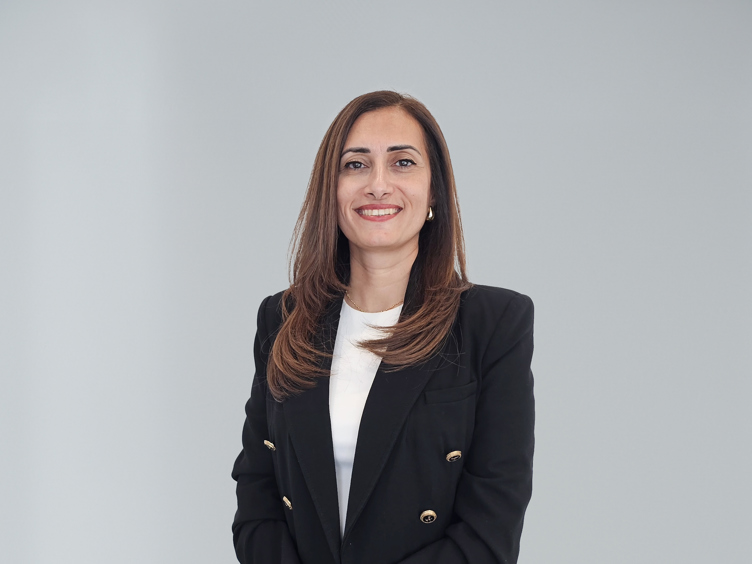
Inspired at Hikma: Building partnerships for growth and to meet patient needs. Meet Lama Shatara, Sr. Director, Business Development & Alliance Management – MENA.
At Hikma, our growth is driven by our people and their determination to create new opportunities. In this employee story, we hear from Lama Shatara, a leader in our Business Development team. Here she talks about her journey from regulatory affairs to business development, and the partnerships helping to strengthen Hikma’s pipeline, and the leadership principles that have shaped her career.
You lead licensing activities across the MENA region. What does your role involve?
I lead the licensing activities for the MENA region, working with a team of very talented people. Our role is to identify innovative and generic products that we cannot develop or manufacture ourselves and bring them into our pipeline through partnerships and licensing agreements.
We work closely with multiple functions across Hikma to make sure the opportunities we pursue are aligned with our regional strategy, including the therapeutic areas and technologies where we see the greatest potential.
The process starts with scouting. We look for companies with innovative products or technologies that could complement our portfolio. In many cases, particularly with generic products, we are looking for complex products that require capabilities or technologies that are not currently available within our own manufacturing network.
From there, we evaluate the opportunities, assess whether the products can be registered and commercialised in the region, and, if there is mutual interest, move into negotiations. A significant part of my role is therefore about building relationships, negotiating agreements and, ultimately, bringing partnerships to life.
What happens once a partnership is in place?
Closing the agreement is just the beginning. We also have an important role in alliance management, which means making sure our partnerships continue to deliver value over the long term.
That can involve solving challenges, discussing new opportunities, expanding territories or adding products to an existing agreement. Sometimes an agreement is coming to an end, and we need to discuss renewal or extension. At other times, there may be opportunities to broaden the relationship in ways that weren't part of the original agreement.
What makes the role particularly interesting is that we work across almost every function in the business as Marketing, Sales, Legal, Intellectual Property, Regulatory Affairs, Medical, Market Access, and Finance. We work across multiple functions to ensure that each opportunity is both strategically attractive and operationally executable.
Ultimately, it's about taking an opportunity and making sure we can successfully bring it to patients.
How did your career journey lead you to Hikma?
I studied pharmacy in Jordan and joined Hikma in 2006, just as the company was entering an exciting period of international growth.
At the time, Hikma had recently listed on the London Stock Exchange, and I remember hearing a lot about this Jordanian-origin company that had grown into an international pharmaceutical business. I wanted to be part of that journey, so I applied before I had even graduated.
I joined the Regulatory Affairs department, working on products for the US market. It was an incredibly valuable experience because I gained exposure to the full product lifecycle, from development and registration through to commercialisation.
At that time, Hikma was one of the relatively few companies from the region with a presence in the US pharmaceutical market, so it gave me a very broad technical foundation and helped me understand both the science behind pharmaceutical products and the business around them.
What made you move from regulatory affairs into business development?
I was attracted to the opportunity because I wanted to explore a different side of the industry. I wanted to combine the knowledge I had gained around pharmaceutical development, manufacturing and science with the world of business.
I also really enjoy change and new challenges, and it's still one of the things I enjoy most today. Every project offers an opportunity to work with different people, products and cultures, while learning something new along the way. That sense of variety and discovery is what attracted me to Business Development, and it's still one of the things I enjoy most today.
Looking back since 2009, what has been one of the biggest lessons from your journey?
One thing that really stands out is how much Hikma has grown. When I joined Business Development, I remember sending introductory emails to potential partners and explaining who Hikma was. Today, Hikma is a much larger global organisation, with a significantly broader network of partnerships and a much larger in-licensed portfolio.
For me, that growth demonstrates something very important: becoming a partner of choice isn't just about having a good product or a good commercial opportunity. It's about building trust and demonstrating that you will deliver on what you promise.
Our partnerships are built on being transparent, reliable and committed. Ultimately, it is the people and relationships that make partnerships successful and sustainable over the long term.
What do you enjoy most about your role?
Negotiation is probably the part I enjoy most. A big part of successful negotiation is listening and asking the right questions. I also love meeting new people. Through this role, I get to work with people from different countries and cultures and learn about different ways of thinking and different needs. That exposure is incredibly interesting and keeps the role fresh.
How would you describe your approach to leadership?
Trust is fundamental. You need to trust your team and give people the space to do things in their own way. Of course, that doesn't mean stepping away completely. I'm always available to support my team, reflect on what we've done, discuss what could have been better and share lessons learned. But I believe people need the opportunity to take ownership.
Earlier in my career, I was fortunate to have people who gave me that opportunity. They guided and supported me when I needed it, while still giving me the space to learn, grow and find my own way.
I believe it is important that we do the same for the next generation, empowering them to remain curious, embrace new technologies in the age of AI and develop the skills needed to shape the future of our industry.
What would you say to someone starting their career and considering business development?
My advice would be to build a strong foundation first. Business development brings together so many different aspects of the pharmaceutical industry, making exposure to different functions incredibly valuable. Experience across areas such as R&D, Regulatory Affairs, Finance can provide a broader understanding of how the different parts of the business connect.
Beyond that, read and stay curious. Learn about what's happening in the global market. Follow how the industry is changing, learn about new technologies and keep up with developments in the science. You don't have to know everything at the beginning. But you should always want to learn more.
What continues to inspire you about the future?
It’s the combination of growth, relationships and challenge. We've seen how much the business can evolve over time, and being part of that journey is incredibly motivating. The opportunities we pursue today can strengthen our pipeline, create new partnerships and ultimately help us bring more products to patients across the region.
But what makes it particularly rewarding is knowing that none of this happens in isolation. It takes people from across the organisation working together, sharing their expertise and finding ways to turn an opportunity into something real.
What continues to make Business Development exciting for me is that there is always something new to learn, someone new to meet and another challenge to solve. Most importantly, there is always another opportunity to make a meaningful difference for patients.